
INPS benefits
Attendance allowance Italy 2026: amounts, requirements and how it works
15 min readCAF Cinisello Balsamo

Quick summary
- What to know right away: 551,53 euro a month, for twelve months, and nobody looks at your income: the attendance allowance is the support INPS gives to people who, although recognised as totally disabled, cannot walk without permanent help or manage the basic acts of everyday life on their own.
- Deadline or duration: The disability reform introduced by legislative decree 3 May 2024, no.
- Who it is for: INPS benefits: application handled by our CAF in Cinisello Balsamo for residents of the surrounding towns.
- Documents and details included: Italian citizenship. · Stable and habitual residence on national territory.
- How to book or get help: Book an appointment: +39 02 8716 5567 · WhatsApp: +39 329 713 9762 · Via Oreste Terenghi, 21/23, Cinisello Balsamo (MI)
551,53 euro a month, for twelve months, and nobody looks at your income: the attendance allowance is the support INPS gives to people who, although recognised as totally disabled, cannot walk without permanent help or manage the basic acts of everyday life on their own. In 2026 the amount is the same for everyone, young and old, and it is not reduced because there is a pension in the house. In this guide we look at who really qualifies, when the payment starts, what can put it on hold and what it has to do with Law 104. To talk through your own situation, come and see us at our patronato CAF in Via Oreste Terenghi 21/23, in Cinisello Balsamo: the application is something we handle for you.



What the attendance allowance is

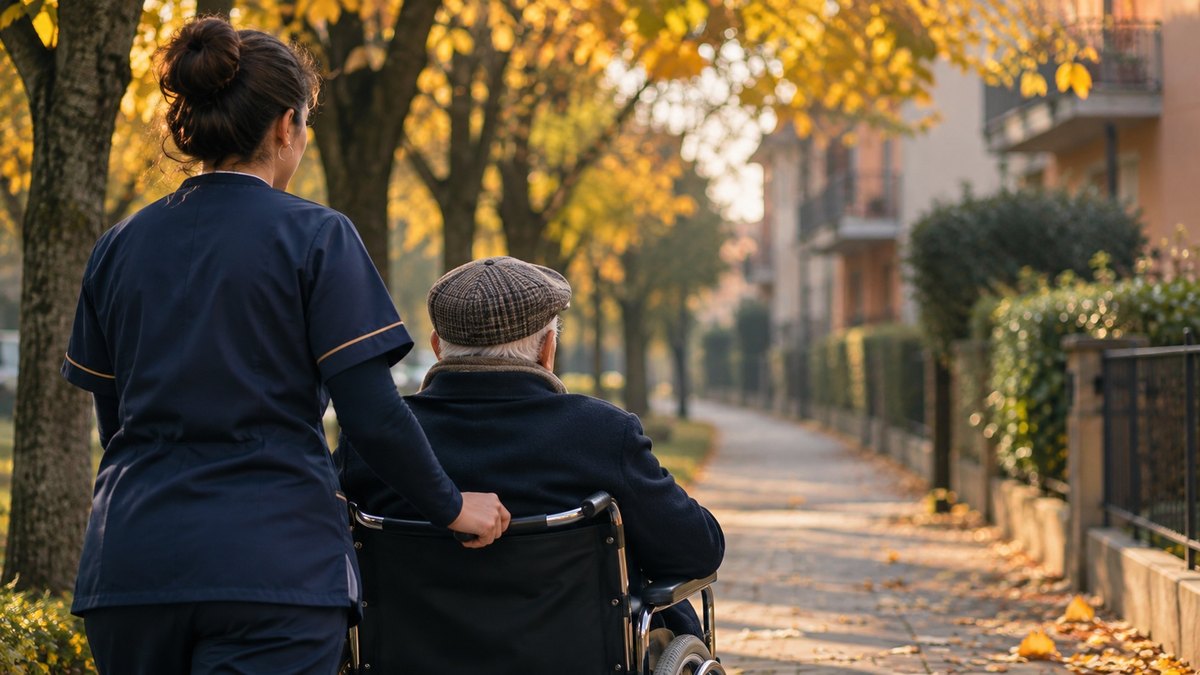
The attendance allowance is an INPS benefit, awarded on application, for people who are mutilated or totally disabled and for whom the medical commission has certified either the impossibility of walking without the help of a carer or the inability to carry out the acts of everyday life alone. Put simply: it is a monthly payment for someone who already holds the recognition of 100% civil invalidity and still needs a person at their side every day, to move around inside the house and outside it.
The best part of this allowance is that it looks at health only, not at the wallet. It is due to every citizen who meets the medical requirements and who lives steadily in Italy, regardless of personal annual income and regardless of age: a high pension or a low one changes nothing, and so does the income of sons, daughters or grandchildren. The money exists to pay for the help the person needs, and for that reason the law wants it within reach of anyone entitled to it.
The two conditions that switch the right on
An ordinary disability is not enough: this allowance was created for severe situations. At the time of the medical visit the commission must have certified, alongside total incapacity, at least one of these two situations.
- The impossibility of walking independently without the permanent help of a carer: someone who does not walk alone, or who can only do so with a person permanently supporting them.
- The impossibility of carrying out the acts of everyday life independently, without continuous assistance: washing, dressing and eating, but also staying alone safely when constant supervision is needed.
The two are alternatives: it is enough that one of them has been certified. A person who still walks but can no longer get through the day alone can have the same right as someone in a wheelchair. It is a distinction that changes the outcome for very many families, and one that is often lost along the way.
Giuliana's case
Giuliana is 78 and lives alone in a flat in Cinisello Balsamo. She walks around the house holding on to the furniture, but since a fall left her without strength she can no longer wash herself or prepare food without help. Her daughter Roberta works full time on shifts and no longer knows how to organise herself. At our patronato CAF we went through her state of health and her paperwork: in her situation the road of the attendance allowance is open, and the file was prepared by us. (An example story, inspired by the cases we see at the office.)
Who can claim it: the medical and administrative requirements

To work out whether the attendance allowance belongs to you or to a member of your family, there are two groups of requirements to line up: the medical ones, which concern the conditions of health certified by the medical commission, and the administrative ones, which concern citizenship and residence. All of them have to be there, but nobody asks for declarations about the income of the household.
The medical requirements
- Recognition of total and permanent incapacity, that is civil invalidity at 100%.
- Recognition of the impossibility of walking independently without the permanent help of a carer, or
- Recognition of the impossibility of carrying out the acts of everyday life independently, without continuous assistance.
The recognition arrives in the report issued by the medical-legal commission at the end of the health assessment: that document is the key to the whole process, because it is there that you read whether the severe condition is present or not. If the report does not mention the need for a carer or for continuous assistance, the allowance does not start, even with an invalidity of 100%.
The administrative requirements
- Italian citizenship.
- For citizens of other EU countries: registration in the resident population register of the municipality of residence.
- For citizens from outside the EU: a residence permit of at least one year, under Article 41 of the Consolidated Immigration Act (Testo Unico sull'Immigrazione).
- Stable and habitual residence on national territory.
These are the same rules everywhere in Italy; they apply to children, to adults and to older people alike, and they do not change with the province you happen to live in. The only thing that really changes is the bureaucratic path, which today is in the middle of a deep reform. We come back to it shortly.
What you receive in 2026: 551,53 euro a month

For 2026 the amount of the allowance is 551,53 euro. That is 551,53 euro a month for 12 monthly payments, so 6.618,36 euro in one year, with the payment arriving every month in the way indicated when the application is prepared. There are no increases linked to age or to the severity of the condition: the figure is identical for every beneficiary.
Two things are worth keeping in mind. The first: there is no thirteenth payment, because the payments are 12 and not 13. The second: the amount is not reduced if the person receiving it has a pension, even a large one, or carries on any kind of paid work. The allowance exists to pay for assistance, and the law does not touch it for that reason.
Where the money comes from
The allowance is paid directly by INPS, every month, by credit to the bank account or by the other method chosen when the application is prepared. It is not a sum granted by the municipality or by the local health authority: it is a national benefit, with the same rules from north to south. In the file we prepare for you at the office we enter the payment details straight away, so that the first credit is not lost because of a wrong IBAN.
A check before starting
Before moving it is worth finding out what you are really entitled to, which documents are needed and which deadlines matter: one consultation at the office saves months of waiting. At the patronato CAF in Cinisello Balsamo the first consultation at the office is free of charge, and you can book it in a few minutes.
When the payment starts and when it stops

The allowance is paid for 12 monthly payments starting from the first day of the month following the submission of the application or, exceptionally, from the date indicated by the health commissions in the report recognising civil invalidity. In practice the month in which the file is submitted does not count: the first payment is the one for the following month, and from then on it arrives every month.
This means that even a short delay can cost a whole month of allowance: if it pushes the application into the following month, the first payment moves with it. It is the reason why, when the report is ready or when the state of health gets worse, it pays to move straight away instead of waiting for the right moment.
A hospital stay can put the allowance on hold
Payment of the allowance is suspended in the case of a stay in hospital fully funded by the State for a period longer than 29 days. The reason is simple: the allowance exists to pay for assistance at home, and during a long hospital stay paid in full by the State that expense no longer exists. If instead a fee is paid, even a partial one, the allowance normally stays.
- Hospital stays, including short ones, must always be reported: they are among the pieces of information we enter into the application ourselves.
- The suspension starts only beyond the 29 days of a stay fully funded by the State.
- On discharge the allowance resumes, but it is always better to check with us that the payment has restarted correctly.
There are then precise rules about what happens when the state of health or the family situation changes: every change deserves attention, because on its own it does not always require a new application, but sometimes it does. A conversation at the office clarifies the road straight away.
From the medical visit to the first payment: how the process works
The path starts with the certifying doctor, who fills in and sends to INPS the introductory medical certificate: that certificate has a validity of 90 days, and within them the application has to be carried on. Then comes the health assessment with the medical commission, and at the end arrives the report of civil invalidity, which is the document that sets the allowance in motion.
Today this path is changing in depth. The disability reform introduced by legislative decree 3 May 2024, no. 62 started as a trial in a number of provinces: nine provinces from 1 January 2025, another eleven from 30 September 2025, and a further group of provinces, among which Milan, from 1 March 2026. Where the trial is active, in many cases the process starts from the medical certificate alone.
For everyone living outside the trial provinces, instead, the previous procedure remains unchanged until 31 December 2026: the administrative application for civil invalidity therefore still has to be sent to INPS, paired with the introductory medical certificate sent by the certifying doctor. These are rules that change province by province and month by month: for this reason, rather than relying on rumours you have heard around, come and ask us. We check the exact procedure that applies to your case and we follow it from the first day to the last.
What we do for you at the CAF
At our patronato CAF we prepare the application, check it and send it: you bring the documents and tell us about the situation, and the rest is on us. This is how we work, step by step.
- We look together at the reports, medical records and certificates, to see whether all the medical requirements are met.
- We prepare and send the application to INPS ourselves, with all the identity, payment and hospital-stay details it asks for.
- We check that the introductory medical certificate is still valid and inside the 90 useful days.
- We follow the process through to the report and to the first payment, and we check that the amount arrives correctly.
One detail worth knowing: the deadline within which the procedure for paying the economic benefit must be concluded is 45 days counted from the date of submission of the payment application, complete with all the mandatory data. And one last thing: with the exception of applications for a worsening of condition, it is not possible to submit a new application for the same benefit until the procedure already under way has run its course.
Come first, then we start
Every month of delay is a month of allowance that never comes back. Book your appointment at the patronato CAF in Cinisello Balsamo, in Via Oreste Terenghi 21/23: we are open Monday to Friday, from 10:00 to 12:30 and from 15:00 to 19:00.
What it combines with and what it does not
Many people believe that the attendance allowance disappears if you work or if you already receive a pension. It does not: the compatibility rules are wider than people think, and it is worth knowing them before letting a right slip through your fingers.
What it is compatible with
- With paid work, whether employed or self-employed, and with holding a special driving licence.
- With the pension for total civil invalidity, with direct contributory pensions and with the survivor's pension: no amount is reduced.
- With the communication allowance and with the allowance for the totally blind, provided that they have been granted for separate impairments, each relating to a different status of invalidity: these are the cases of people with multiple impairments.
What it is not compatible with
The attendance allowance is incompatible with similar benefits granted for disabilities contracted because of war, work or service. In these cases the law does, however, leave the choice: the citizen is given the option of exercising the right to opt for the more favourable treatment. If you are in a situation of this kind, we work out together at the office which road is the convenient one.
Does it count as income? No, and it is excluded from ISEE
One of the questions we are asked most often is whether the attendance allowance counts as income. The answer is no: attendance allowances fall among exempt income, the kind that does not take part in forming total income and does not bear on the tax bill. There is more: thanks to Article 2-sexies of decree-law no. 42 of 2016, the welfare and indemnity payments received because of a condition of disability are excluded from disposable income for ISEE purposes. For a family this means that the allowance does not push the indicator up, and does not put at risk the other benefits linked to ISEE.
Beware of the wrong stories
You hear all sorts around: that the allowance is lost if you work, that it counts for ISEE, that it is only due above a certain age. Not one of these is true. Before giving up a right, bring us your documents and we look at your real case.
What to bring to the appointment and what changes for minors
If you have decided to ask for the attendance allowance, the next step is a simple one: book the appointment and prepare the folder of documents. You do not have to arrive with everything perfect, but the more you bring, the faster the file moves.
- Identity document and tax code (codice fiscale) of the person claiming the allowance and of the person who accompanies them.
- The report of civil invalidity already in your possession, if there is one, together with the medical records and certificates that describe the state of health.
- Any SPID or CIE: if you have them, bring them to the appointment, because they are used to identify the application.
- The IBAN of the account on which to receive the payment.
- For minors, the documents of the parent who signs the application.
Minors who hold it: what happens at legal age
Minors who hold the attendance allowance, on reaching legal age, must submit form AP70 for the payment of the benefit as an adult, in the form of the incapacity pension, without any need for further health assessments. It is a delicate passage because it has deadlines of its own: if there is a young person at home who already receives the allowance, tell us when you book, so that we prepare everything in good time.
The attendance allowance is one of those benefits that genuinely change the life of a family, and yet too often they come to light too late. If you think that in your situation the grounds are there, do not wait for the perfect moment: come and see us, we assess the case together and we take care of everything, from the first document to the first payment.
Book your appointment
We are waiting for you at the patronato CAF in Cinisello Balsamo, in Via Oreste Terenghi 21/23, Monday to Friday from 10:00 to 12:30 and from 15:00 to 19:00. You can book online or call us: for the attendance allowance the consultation at the office is something we go through together, one step at a time.
Document checklist: check your application in 30 seconds
Tick the documents you already have: you arrive prepared at the counter and avoid a second trip.
0/7
Time saved at the counter: up to 30 minutes
Message us on WhatsAppQuestions we get most often
Does the attendance allowance count as income?
No. It falls among exempt income and does not take part in forming total income, so it is not taxed. On top of that, the payments received because of a condition of disability are excluded from disposable income for ISEE purposes: receiving the allowance does not push up your household indicator.
How much do you get with the attendance allowance in 2026?
In 2026 the amount is 551,53 euro a month, for 12 monthly payments, so 6.618,36 euro in one year. The figure is equal for everyone and does not depend on income, on age or on the presence of a pension.
Do you need a low income to obtain it?
No. The attendance allowance is due regardless of personal annual income and regardless of age, provided that the medical and administrative requirements are met. The high pension of a parent or the income of the children counts for nothing.
What is the difference between attendance allowance and Law 104?
They are two different recognitions. The attendance allowance is an economic benefit for the totally disabled person who cannot move or live alone without help; Law 104, instead, concerns the state of severe handicap, with permits and leave dedicated to whoever looks after the person. Very often the same family needs both: at our patronato CAF we work out together which is your case.
What happens in case of a hospital stay?
Payment of the allowance is suspended in case of a stay in hospital fully funded by the State for a period longer than 29 days, because in those conditions the assistance at home is no longer necessary. Hospital stays must always be reported, and on discharge it is we who check that the payment restarts correctly.
Recommended
- 730 / Income Tax Return
- pre-filled 730 2026 - Pre-filled 730 2026: what it is, the dates and how to check it
- when does the CUD arrive - CUD INPS 2027: when it arrives and who receives it
- child tax deduction 730 - Child tax deduction 730 2026: how to claim for your children without mistakes
- mortgage deduction 730 - Mortgage deduction 730: how to claim back the interest on your first home
- pensioners tax return Italy - Pensioners tax return 2026: who must file and how to do it
- mortgage interest deduction 730 - Mortgage interest deduction 730: how much you get back every year
- medical expenses deduction 730 - Medical expenses deduction 730: how to get 19% of your treatment costs back
- CU Italy 2027 - CU Italy 2027: the Italian Single Certification, what it is for and when it arrives
- correct 730 after filing - Correct 730 after filing: how to fix it after the deadline
- 730 integrativo deadline - 730 integrativo deadline 2026: what it is and when to file
- 730 refund when does it arrive - 730 refund 2026: when it arrives and how to check the payment
- 730 in debit - 730 in debit: what happens and how to put it right, step by step
- Italy pre-filled 730 - Pre-filled 730 Italy: what it is and how to check it without mistakes
- 730 tax return deadline - 730 tax return deadline 2026: 30 September is the last day to file
- IMU and Local Taxes
- imu 2026 first instalment - IMU 2026: the first instalment on 16 June, who pays and how it is calculated
- IMU deadlines 2026 - IMU deadlines 2026: the June instalment and the dates you cannot miss
- IMU deadline 2026 - IMU deadline 2026: the right dates and the sums that add up
- imu rates cinisello balsamo - IMU in Cinisello Balsamo: the 2026 rates
- imu 2026 second instalment - IMU 2026: the second instalment due 16 December
- tari 2026 deadline - TARI 2026 deadline: instalments and final balance in Cinisello Balsamo
- NASpI and Unemployment
- naspi application cost - NASpI application cost: what you pay and what the service includes
- NASpI benefit buying a home - NASpI benefit and buying a home: what you really get and how to move
- when does naspi payment arrive - NASpI payment: when it arrives and how to check the credit
- how to apply for naspi - How to Apply for NASpI 2026: Eligibility, Deadlines and Amounts
- Modello Redditi PF (formerly Unico)
- IRPEF instalment payment code - IRPEF instalments and payment code: the guide to the November payment
- file a late tax return - Omitted tax return: how to fix it without losing your head
- F24 advance payment deadline - F24 advance payment deadline 2026: 30 November and how to get it right
- Italy tax return deadline 2026 - Modello Redditi PF 2026 Deadline: the two November dates to remember
- Tax Advice and Disputes
- register for VAT in Italy - Register for VAT in Italy 2026: the deadlines of your first year
- INPS tax bill instalments - INPS tax bill instalments: how to pay monthly without losing the plan
- F24 third-quarter deadlines - Third-quarter F24 deadlines: advance payment, VAT and what to do if you pay late
- Italy tax advance payments 2026 - Income tax advances 2026: what you pay in November and what you pay in December
- Patronato INPS and Pensions
- 13th month pay 2026 when it arrives - 13th month pay 2026: when it arrives and who gets it
- early retirement for women Italy - Early retirement for women: requirements, exit windows and 2027 changes
- tfr from 1 july 2026 - TFR from 1 July 2026: what changes and how you choose
- ISEE and DSU
- pre-filled ISEE INPS - Pre-filled ISEE INPS: what it is, what it contains and how to file it
- dsu 2026 isee - DSU 2026: when to request it and how to file it without errors
- ISEE 2026 income 2024 - ISEE 2026 income 2024: what you need and how to prepare the DSU
- Tax Bonuses and Reliefs
- ENEA tax deduction 2026 - ENEA tax deduction 2026: rates, notification and deadlines
- Italy home renovation bonus 2026 - Home renovation bonus 2026: how much you get back and how to claim it
- Italy driving licence bonus 2026 - Driving licence bonus 2026: who gets it and how the voucher works
- Assegno Unico and Social Bonuses
- energy bills bonus 2026 - Energy bills bonus 2026: discounts on electricity, gas, water and waste
- italy single allowance 2026 - Italy single allowance 2026 and newborn bonus: the real figures and the dates to remember
- Immigration and Residence Permits
- work residence permit italy subordinate work - After the nulla osta: visa, contract of stay and work permit
- flows decree employer requirements italy - Flows Decree for employers: requirements, documents and mistakes to avoid
- Tenancy Agreements
- rental contract types - Rental contract types and deadlines: what to check
- cedolare secca 2026 - Cedolare secca and rental income in 2026: rates, dates and the right choices
- Inheritance and Cadastral Transfers (Volture)
- inheritance deadlines - Inheritance deadlines: what has to be filed and when
- Cadastral and Mortgage Searches (Visure)
- land registry search - Land registry search: when you really need one and how to request it
- SPID and Digital Identity
- SPID and CIE - SPID and CIE: what they are for and when you need them
- Domestic Staff and Carers (Colf and Badanti)
- italy work visa 2027 - Decreto Flussi 2027: quotas, click day on 12 January and how to apply
Contact us
You will find us at Via Oreste Terenghi, 21/23, 20092 Cinisello Balsamo (MI), opposite the ASL. Call us or message us on WhatsApp to book an appointment. Quote always given before we start. We will see you at Via Oreste Terenghi, 21/23, 20092 Cinisello Balsamo (MI).